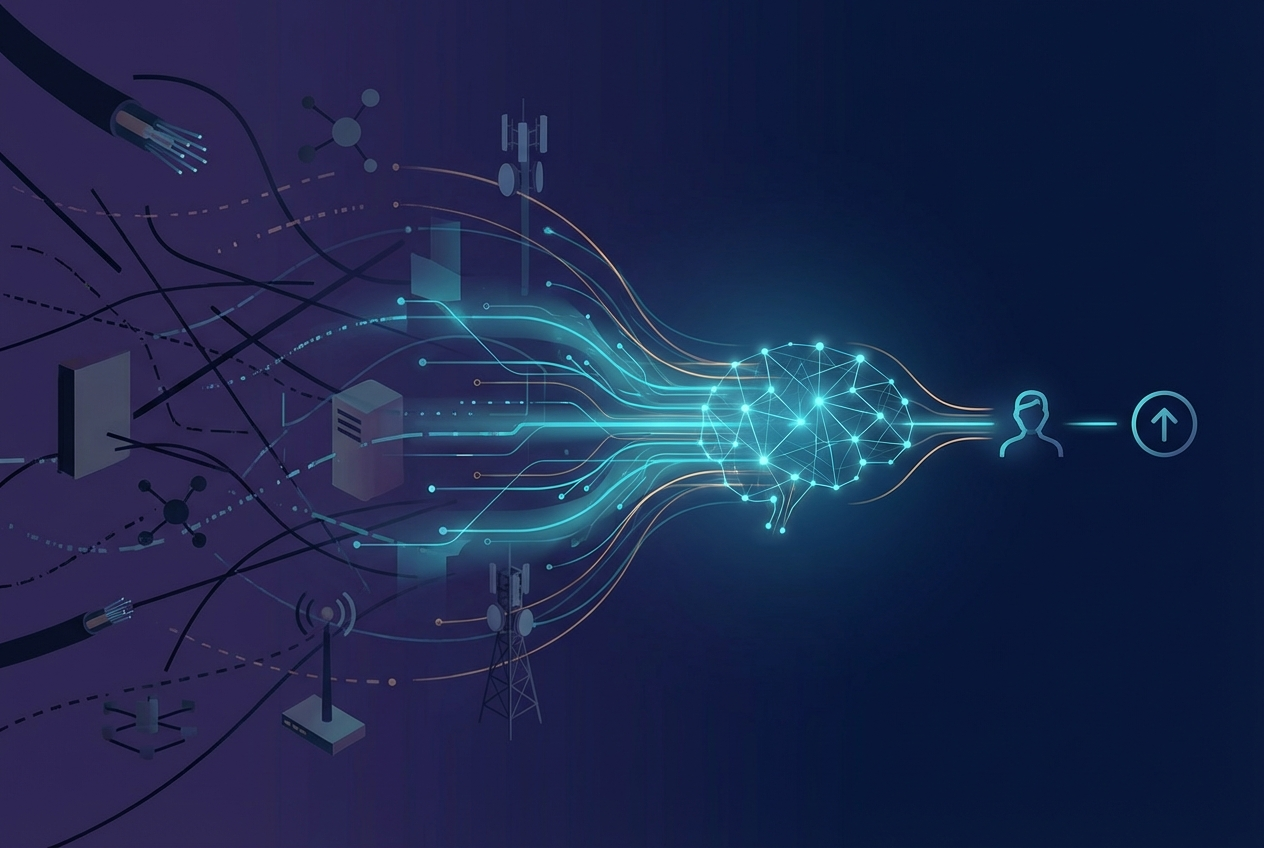
The telecom industry doesn’t lack AI pilots.
It lacks AI impact.
Every executive has seen it by now:
-
Promising demos
-
Smart models
-
Strong vendors
-
Minimal operational change
-
Near-zero ROI
So the conclusion becomes: “AI isn’t ready for telecom.”
That conclusion is wrong.
AI isn’t failing in telecom.
Telecom is trying to adopt AI without fixing the real problem.
The Real Problem: Telecom Doesn’t Have an AI Problem
It Has a Systems Problem
Most telecom operators run on:
-
Disconnected OSS
-
Disconnected BSS
-
Generic CRMs
-
Siloed NOCs
-
Manual escalations
-
Tribal operational knowledge
AI is then layered on top as:
-
A dashboard
-
A chatbot
-
A report
-
A pilot
That’s not AI adoption.
That’s AI theater.
AI cannot save a business that cannot act on its own data.
Until that changes, AI will always feel “stuck.”

Why AI Feels Broken in Telecom (But Isn’t)
Executives are told AI will:
-
Predict churn
-
Optimize ops
-
Reduce costs
-
Improve CX
Yet in reality:
-
Insights don’t trigger actions
-
Recommendations aren’t enforced
-
Alerts are ignored
-
Humans still coordinate everything
So AI becomes informational, not operational.
And informational systems do not move the needle in a 24/7 network business.

System of Record vs System of Action (The Missing Distinction)
This is the concept most AI conversations in telecom completely miss.
System of Record
-
Stores data
-
Tracks history
-
Supports reporting
-
Requires humans to act
CRMs, OSS, BSS all fall here.
System of Action
-
Detects events in real time
-
Understands context (network, customer, revenue)
-
Decides what must happen next
-
Triggers actions automatically
Most telecoms don’t have one.
They have systems of record pretending to be intelligent.
System of Action (Telecom)
A system that ingests real-time network, customer, and revenue data — and is authorized to autonomously trigger operational and commercial actions without human orchestration.
Without this, AI cannot deliver ROI.

Why “Adding AI” to Existing Systems Doesn’t Work
Telecom leaders are often told:
-
“Add AI to your CRM”
-
“Deploy AI in support”
-
“Use AI for churn prediction”
But those systems were never designed to:
-
React in real time
-
Enforce decisions
-
Coordinate cross-team actions
-
Balance SLA vs revenue vs risk
So AI ends up making recommendations to systems that can’t respond.
That’s why pilots stall.
That’s why nothing changes.
The Five Hard Requirements for Real AI Adoption in Telecom
If an AI strategy doesn’t meet these, it will fail – quietly.
1. Network Telemetry Must Be a First-Class Signal
AI that doesn’t understand:
-
Uptime
-
Latency
-
Congestion
-
Device behavior
Is blind.
Customer data without network truth is noise.
2. AI Must Be Event-Driven, Not Report-Driven
AI must respond to:
-
Outages
-
Degradation
-
Usage spikes
-
Repeated failures
-
Behavior changes
Not monthly dashboards.
Telecom is a real-time business.
3. AI Must Have Permission to Act
If AI cannot:
-
Open tickets
-
Escalate incidents
-
Dispatch support
-
Trigger calls or messages
-
Apply credits
-
Recommend offers
Then it’s analytics — not intelligence.
4. Revenue Must Be a First-Class Signal
AI must understand:
-
Customer value
-
SLA tier
-
Contract terms
-
Churn risk
-
Upside opportunity
Treating a $30 customer and a $3,000 customer the same is operational malpractice.
5. Humans Must Become Supervisors, Not Operators
AI works when:
-
Humans define policy
-
AI executes continuously
-
Humans intervene on exceptions
If AI needs approval at every step, it will always lose.

The Point Most Vendors Avoid Saying Out Loud
This is where the conversation gets uncomfortable.
AI cannot be imposed on telecom from the outside.
Anyone proposing to “solve AI in telecom” without living inside telecom operations will fail.
Vendors vs Real Partners (The Difference That Decides Success)
❌ Vendors
-
Think in features
-
Sell pilots
-
Integrate around systems
-
Leave when the demo ends
They don’t:
-
Sit in the NOC
-
Understand escalation paths
-
Experience outages
-
Feel SLA pressure
-
See where workarounds exist
✅ Partners
-
Are embedded in day-to-day operations
-
Understand fragmentation because they live it
-
Design AI around real workflows, not diagrams
-
Stay when things break
-
Build with ops, not just IT
They don’t “deploy AI.”
They rebuild how decisions happen.
AI Partner (Telecom)
A technology partner embedded in daily telecom operations who designs AI systems around real workflows, constraints, and fragmentation not idealized architectures or surface-level integrations.
This is the credibility filter most vendors fail.
Why Most AI Pilots Die Quietly
Every telecom executive has seen this pattern:
-
AI pilot launches
-
Demo looks impressive
-
Ops teams ignore it
-
Workarounds continue
-
Actions still require humans
-
ROI never materializes
-
AI is quietly shelved
The failure wasn’t AI.
The failure was lack of operational authority and partnership depth.
The Warning Telecom Leaders Need to Hear
This isn’t about hype.
It’s about reaction speed.
Telecoms that treat AI as a feature upgrade will fall behind.
Telecoms that redesign their operating model around AI will quietly pull away and never give the gap back.
The winners won’t announce it.
They’ll just respond faster, retain better, and monetize smarter.
What Real AI Adoption Actually Looks Like
It looks like:
-
Network events instantly triggering customer actions
-
Revenue risk prioritized automatically
-
Support escalated before customers complain
-
Upsell opportunities detected in real time
-
Humans supervising systems not chasing alerts
This is not a tool change.
It’s an operating model change.
Final Thought
AI is not stuck in telecom.
Telecom is trying to adopt AI without changing how it operates
and without choosing partners who truly understand the business.
The telecoms that get this right won’t just “use AI.”
They’ll run on it.
A Practical Next Step
If this article resonated, here’s a concrete way to move forward.
We’re offering 3 free AI operating model consultations to the first three ISPs or telecom operators who reach out.
This is not a sales demo.
It’s a working session focused on:
-
Mapping your current OSS / BSS / CRM fragmentation
-
Identifying where AI is actually blocked today
-
Defining what a real System of Action would look like in your operation
-
Pressure-testing what can be automated now vs later
No slides.
No buzzwords.
Just an honest assessment from people who work inside telecom operations every day.
If you’re an operator who knows something is broken and wants clarity before making the next AI decision this is for you.
👉 Contact us at: https://impulse.ky/contactus
Message: AI Operating Model Consultation
Once the three spots are filled, we’ll close this.