



What Every Monitoring Stack Is Missing
Every ISP we’ve ever worked with has monitoring.
Zabbix. LibreNMS. SmartOLT. Checkmk. PRTG. Maybe a homegrown stack built on VictoriaMetrics and Grafana.
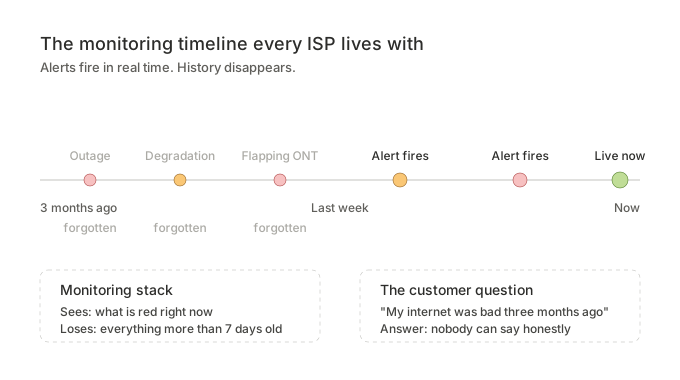
The dashboards look great. The alerts fire when something breaks. The NOC knows what’s red right now.
Then a customer calls and says:
“My internet was terrible last Tuesday around 4pm.”
And the whole stack goes quiet.
Because every monitoring tool on the market is built to tell you one thing:
What’s happening right now.
Almost none of them are built to tell you:
What happened, to whom, how often, and whether it’s getting worse.
That’s not a monitoring problem. That’s a memory problem.
Telemetrics Already Had the Plumbing. Now It Has the Brain.
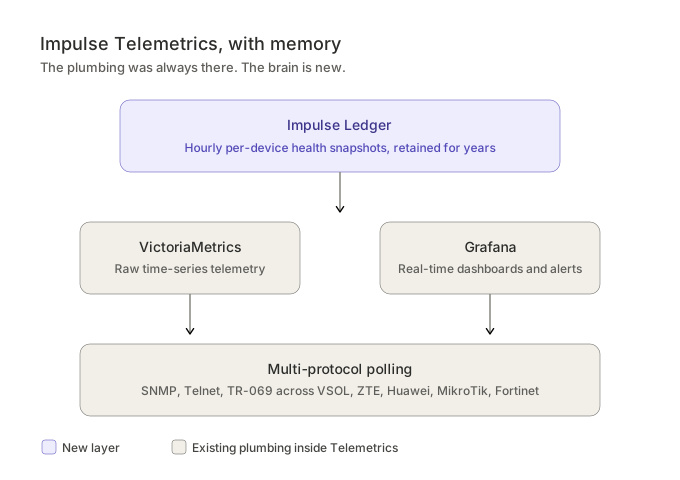
Impulse Telemetrics has always shipped with a serious foundation:
- VictoriaMetrics for high-cardinality time-series storage
- Grafana for visualization
- Multi-protocol polling – SNMP, Telnet, TR-069 – across VSOL, ZTE, Huawei, MikroTik, Fortinet, and more
- Real-time alerting tied to network state
That’s the plumbing. It’s the same plumbing the hyperscalers use. It works.
But plumbing isn’t memory.
Raw metrics in VictoriaMetrics are points on a graph. Dashboards in Grafana are a snapshot in time. Neither of them tells you what a device actually went through last month.
That’s the gap the Impulse Ledger fills.
Introducing the Impulse Ledger
The Ledger is the new memory layer inside Impulse Telemetrics.
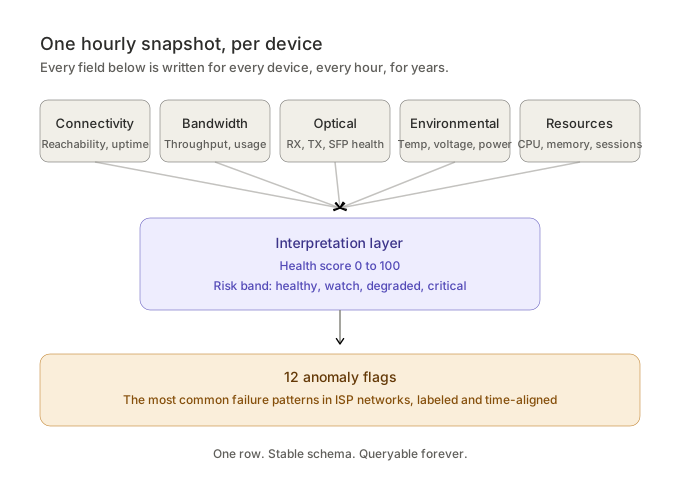
Every hour, for every device on your network, the Ledger writes one row.
Each row contains:
- Connectivity – reachability, uptime, session stability
- Bandwidth – throughput, utilization, committed vs delivered
- Optical – RX/TX levels, SFP health, FTTH signal quality
- Environmental – temperature, voltage, power
- Resources – CPU, memory, session counts
- A health score from 0 to 100
- A risk band – healthy, watch, degraded, critical
- 12 anomaly flags covering the most common failure patterns in ISP networks
One row. Per device. Per hour. Forever.
That’s the Ledger.
Impulse Ledger The memory layer inside Telemetrics. Hourly, per-device health snapshots in a stable schema, retained for years – feeding reports, dashboards, triage, and AI.
Why a Memory Layer, Not Another Dashboard
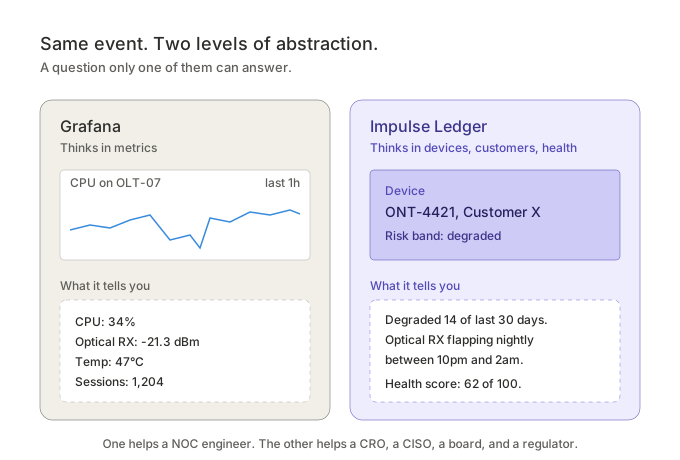
Grafana is great at answering “what does this metric look like over time?”
It’s terrible at answering “how has this customer been doing this quarter?”
That’s not a Grafana problem. It’s a level-of-abstraction problem.
Grafana thinks in metrics. The Ledger thinks in devices, customers, and health.
Grafana shows you CPU on OLT-07. The Ledger tells you:
Customer X’s ONT has been in the “degraded” risk band for 14 out of the last 30 days, with optical RX flapping nightly between 10pm and 2am.
One of those sentences helps a NOC engineer. The other one helps a CRO, a CISO, a support manager, a regulator, and a board member.
That’s the jump.
Retention Built for Humans, Not Just Machines
VictoriaMetrics is already tuned for metrics retention inside Telemetrics.
The Ledger is tuned for decisions:
- 31 days hourly – for detailed investigation and triage
- 365 days daily – for trend analysis and customer reviews
- Weekly forever – for long-horizon patterns and executive reporting
MongoDB TTL rolls it up automatically. No manual archiving. No pipelines to babysit.
When a customer says “my internet was bad three months ago” – you have the answer.
When a regulator asks “what was your uptime last year” – you have the answer.
When a board member asks “is our network degrading over time” – you have the answer.
How It Works Under the Hood
The Ledger is a single Go binary called featuresnapshotter
It reads from:
- VictoriaMetrics – the raw telemetry you’re already collecting
- MongoDB – device identity, customer mapping, contract tier, history
It exposes 10 REST endpoints for querying snapshots, health history, anomaly flags, and feature vectors.
No new database to operate. No extra infrastructure to buy. No vendor lock-in.
It runs inside the Telemetrics stack you already have.
If you’re already running Impulse Telemetrics, we will be rolling out this feature for FREE to all of customers who are with us now and who will join in Q2 and Q3
What’s Already Running on Top
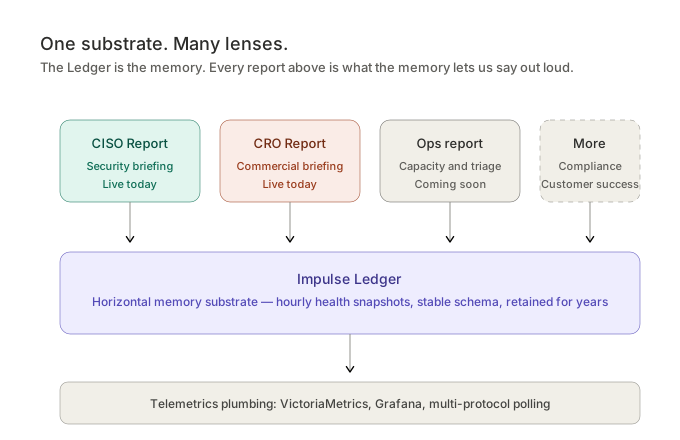
The Ledger is horizontal. The applications sitting on top of it are vertical.
The first two are already live:
- Impulse CISO Report – on-demand security briefing generated from Ledger data in about 15 seconds
- Impulse CRO Report – on-demand commercial briefing from the same data, different lens
Both are covered in separate posts.
More are coming. Compliance. Operations. Capacity. Customer success. Same pattern every time: raw telemetry → interpretation → decision-grade artifact.
Who This Is For
This is for:
- CTOs tired of losing history every 30 days
- NOC leaders who want triage context, not dashboards
- CFOs who need audit trails that actually exist
- ISPs building toward AI but drowning in messy, unlabeled data
If you’re already on Impulse Telemetrics, you’re getting the Ledger.
If you’re not – this is the reason to look.
The Reality
Every telecom has monitoring.
Very few telecoms have memory.
The Ledger gives your network a memory.
Everything else becomes possible from there.
👉 Already on Telemetrics? The Ledger is waiting for you. Contact us to enable it.
👉 Not on Telemetrics yet? Contact us – subject line: “Telemetrics + Ledger Demo”


